
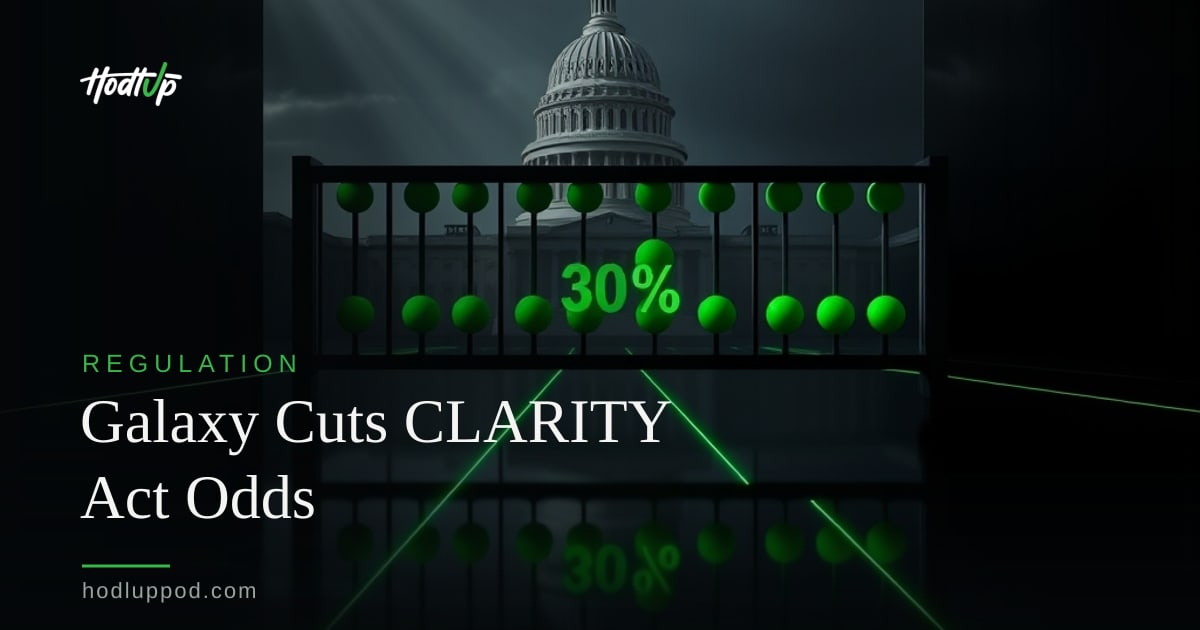
Galaxy Digital Research has significantly lowered its projection for the CLARITY Act's passage by the end of 2026, reducing the probability from 50% to just 30% as of July 24. This revised outlook, articulated by Galaxy's Research Director Alex Thorn, comes amid ongoing Senate negotiations and persistent bipartisan disagreements over key provisions of the comprehensive crypto market structure bill. The updated assessment highlights the increasing legislative hurdles facing the landmark legislation designed to provide regulatory clarity for digital assets in the United States.
Current Legislative Status
The Digital Asset Market Clarity Act, also known as the CLARITY Act, is currently navigating the U.S. Senate. The House of Representatives passed its version (H.R. 3633) on July 17, 2025, with strong bipartisan support. More recently, in May 2026, the Senate Banking Committee advanced its version of the bill with a 15-9 bipartisan vote. However, the path to a full Senate vote and presidential signature remains complex, with a critical deadline approaching before the August recess.
Reasons for Reduced Odds
Alex Thorn of Galaxy Digital Research pointed to several factors contributing to the lowered passage odds. A significant shortfall in votes is a primary concern, with reliable Republican support estimated at around 50 votes, short of the 60 needed to overcome a filibuster. Additionally, seven Democratic senators who were previously involved in negotiations have issued a joint statement deeming the current text "inadequate". Their objections specifically target provisions related to ethics clauses, which they argue are too weak and solely entrusted to the Department of Justice, as well as a 2029 sunset clause. Senator Elizabeth Warren has explicitly called for the bill's rejection.
Key Sticking Points
The core of the current debate revolves around ethics provisions, particularly conflict-of-interest disclosures for elected officials holding crypto assets. While the Republican draft includes such limits, Democrats are pushing for stronger revisions. Other contentious areas include consumer protection, anti-money laundering (AML) provisions, and differences between the Senate Banking and Agriculture Committee drafts, especially concerning stablecoin rewards. The bill aims to clarify jurisdictional boundaries between the SEC and CFTC, protect open-source developers, and establish unified consumer safeguards.
Background on the CLARITY Act
The CLARITY Act represents a significant effort to establish a comprehensive regulatory framework for digital assets in the U.S., an industry that has long operated without dedicated federal oversight. For years, the U.S. crypto industry has faced regulatory uncertainty, with the SEC and CFTC often asserting overlapping claims over digital assets. The bill seeks to resolve this ambiguity by categorizing digital assets and defining the regulatory obligations of each agency, moving away from a "regulation by enforcement" approach. Earlier iterations of similar legislation have been discussed for several years, with the current version building on previous efforts like the GENIUS Act, which focused on stablecoins.
What to Watch
The immediate focus is on the Senate, with a critical deadline of July 30 for procedural advancement before the August recess. Failure to pass the bill before this period would significantly diminish its prospects for becoming law in 2026. Should the CLARITY Act pass, it is expected to provide much-needed regulatory certainty, potentially unlocking institutional capital and fostering innovation in tokenized securities, real-world assets, and institutional DeFi. Conversely, a stall or failure would maintain the current regulatory ambiguity, forcing the industry to continue relying on agency guidance rather than a clear legislative framework. The ongoing negotiations over ethics and consumer protection provisions will be crucial in determining the bill's fate.
Original announcement: Galaxy Digital Research