
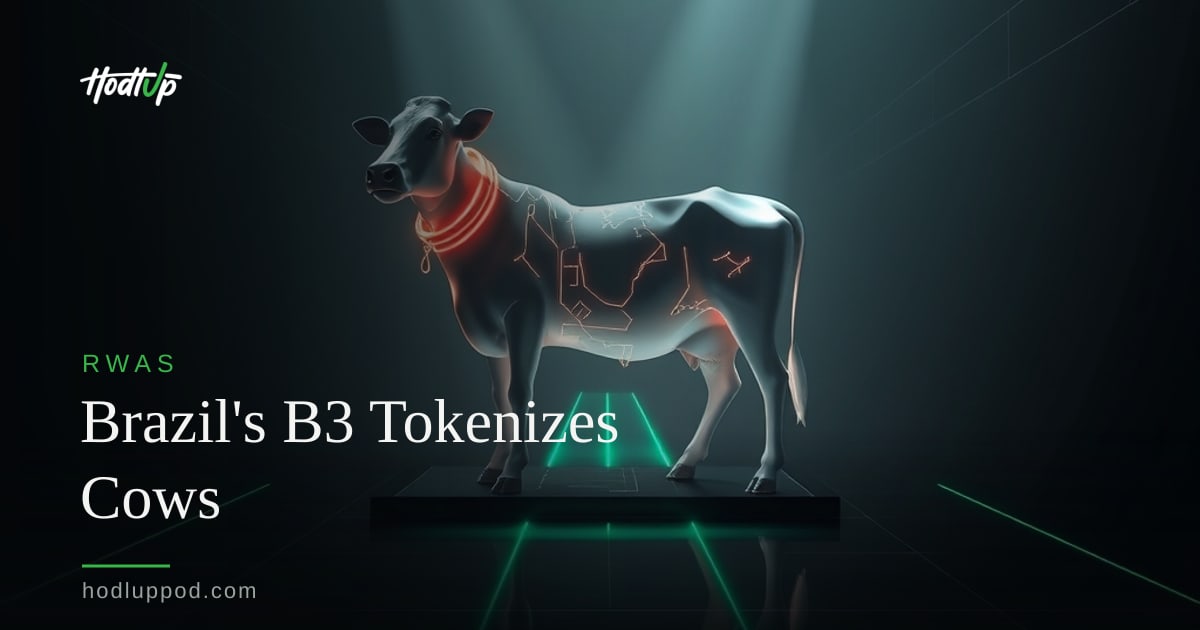
Brazil's national stock exchange, B3, recently registered its inaugural credit facility collateralized by tokenized live dairy cattle, marking a significant advancement in real-world asset (RWA) tokenization. This pioneering transaction saw a farm in Paraná secure a R$100,000 (approximately $19,400 USD) loan, backed by ten digitally identified dairy cows. The initiative offers a novel financing solution for Brazilian farmers grappling with stringent traditional lending limits.
Innovative Collateral Mechanism
The groundbreaking loan was secured by ten dairy cows from Fazenda Engenho Velho in Imbituva, Paraná, collectively valued at R$120,000 (approximately $23,310 USD). The tokenization process is facilitated by Cowmed, a Brazilian agtech company, which equips each animal with an AI-powered Smarty Collar. These collars continuously monitor the cows' health, behavior, and location, converting this raw data into a unique, encrypted digital identity. This digital identity is then linked directly to the credit agreement and registered on B3, Brazil's primary stock exchange.
This real-time monitoring system addresses a critical challenge in traditional agricultural lending: the difficulty of verifying the condition and existence of livestock collateral. Historically, lenders applied substantial discounts, sometimes up to 60%, to cattle values due to risks like mortality, disease, or theft. By providing continuous, verifiable data, the tokenized approach significantly reduces lender risk and allows for a tighter collateralization ratio, in this case, 1.2x.
Key Players and Transaction Structure
The transaction was structured by Target FIDC, a Brazilian investment fund, and the initial funds were provided by BMP Sociedade de Crédito Direto. The loan itself is a Cédula de Produto Rural Financeira (CPR-F), a specialized rural product certificate that allows farmers to borrow against agricultural assets. Target FIDC acquired the credit rights and subsequently registered the structured note on B3, making it the first formal instance of tokenized livestock collateral on the exchange.
Cowmed CEO Thiago Martins highlighted the transformative potential, stating that converting tangible biological assets into monitored digital instruments enables farmers to secure credit at lower costs and with higher borrowing ceilings. Target FIDC director Humberto Brenner noted that continuous monitoring eliminates the uncertainty that traditionally led to deep discounts on livestock collateral.
Broader Implications for RWAs in Brazil
This pilot project comes at a crucial time for Brazil's agribusiness sector, which has faced a deepening credit crisis. Agricultural bankruptcy filings in Brazil surged to 1,990 in 2025, nearly four times the 534 recorded in 2023. The tokenization of real-world assets like livestock offers a vital new avenue for liquidity and financial stability for small and mid-sized producers.
The successful registration on B3 also aligns with the exchange's broader strategy to expand its digital asset infrastructure. B3 is actively developing its own tokenization platform and plans to launch a Brazilian Real-pegged stablecoin in 2026. This move positions B3 as a key player in the evolving market for tokenized real-world assets, which is projected to grow significantly, with some forecasts reaching trillions of dollars by 2030.
Following this initial success, Target FIDC is reportedly evaluating four additional Brazilian farming operations, with a goal to facilitate R$5 million (approximately $971,000 USD) in tokenized livestock loans by the end of 2026. Cowmed, which currently monitors around 100,000 cows across multiple countries, anticipates that up to 20% of its monitored herd, valued at R$400 million (approximately $77.6 million USD), could be converted into tokenized credit guarantees within the next two years. The performance and adoption of these early loans will be crucial indicators for the wider expansion of tokenized agricultural assets in Brazil and potentially globally.
Original announcement: Crypto Briefing